For more than two centuries, thread carried Paisley’s name farther than the town itself. Clark and Coats sewing cotton reached counters worldwide; the firms that made it reshaped Renfrewshire’s streets, skyline, and working life.
This page traces Seedhill and Ferguslie, global expansion and the 1896 amalgamation, civic philanthropy, labour tradition, and the late end of local production — then what still stands to visit.
Explore more: Paisley Heritage & History · Paisley Abbey: From Priory to Parish · How Kashmir’s Motif Became “Paisley” · Sma’ Shot Day · Paisley Museum campus (redevelopment underway — check OneRen for current visitor info)
From weaving town to thread capital
By the early nineteenth century Paisley was a major weaving centre, soon famous for Kashmir-style shawls that gave the world the “Paisley” pattern. The same textile culture produced the next industry.
In 1806 Napoleon’s blockade cut off silk for heddle threads. Patrick Clark developed a strong three-ply cotton substitute; Coats heritage dates its marketing from 1812. The yarn quickly became sewing thread, just as mechanisation and the sewing machine multiplied demand.
As shawl fashion faded, cotton thread — not the loom shop alone — defined modern Paisley. Pattern story: How Kashmir’s Motif Became “Paisley”.
Clark at Seedhill and Anchor
James and Patrick Clark came to Paisley in the 1750s and built a trade in heddle twine from Cotton Street. After the cotton-thread breakthrough the firm grew as J. & J. Clark.
In 1817 a Seedhill factory mechanised production. From that base rose the Anchor works — spinning, twisting, finishing, and the red-brick east-side skyline. Clark sold sewing cotton on spools rather than hanks, and used counter cabinets and colour cards to brand the product worldwide.
In the 1860s Clark opened a mill in Newark, New Jersey. At home, Anchor wealth underwrote civic gifts — above all the Town Hall opposite the Abbey.
Coats at Ferguslie
James Coats (born 1774), from a weaving family, worked in silk and canton crepe before turning to thread. In 1826 he built a small mill at Ferguslie; on retiring in 1830, sons including James, Peter, Thomas, and Andrew formed J. & P. Coats.
Ferguslie became one of Scotland’s great industrial landscapes — mills, gatehouses, counting houses, and chimneys on the western approaches. In the 1860s Coats established production at Pawtucket, Rhode Island. Competition with Clark was fierce until amalgamation joined them.
Global expansion and the 1896 amalgamation
Both firms rode the sewing-machine age and built multinational sales networks early. In 1890 J. & P. Coats listed on the London Stock Exchange. In 1896 Coats and Clark amalgamated — with American associates and English houses Brook of Meltham and Chadwick of Bolton — as J. & P. Coats Ltd.
Company heritage for that merger era cites about £22 million market value, roughly 25,000 shareholders, and over 50,000 employees worldwide. That headcount is global, not a Paisley payroll. Locally, Anchor and Ferguslie still employed thousands; exact local peaks vary by source.
By the early 1910s, Coats ranked among the world’s largest listed firms by market capitalisation — company heritage places it third after US Steel and Standard Oil at one point.
Philanthropy and the civic skyline
Thread profits paid for much of the Victorian town visitors still photograph.
- Paisley Museum and Free Library — Gifted by Sir Peter Coats; opened 1871 (later extended). Core of today’s High Street museum campus.
- Paisley Town Hall (George A. Clark Town Hall) — George Aitken Clark’s bequest, completed with Clark family support; opened 1882; architect W. H. Lynn. Faces the Abbey across Abbey Close.
- Coats Observatory — Funded by Thomas Coats; opened 1 October 1883. Scotland’s oldest surviving purpose-built public observatory; once fed corrected time to clocks including the Town Hall. Part of the museum campus (closed during redevelopment — check OneRen).
Churches, schools, hospitals, and welfare schemes also carried the family names. The skyline is industry’s civic afterlife.
Work, wages, and civic memory
Thread mills employed generations of Paisley women and men. In 1856 shawl weavers won payment for the unpaid “sma’ shot” — fine weft invisible in the finished cloth — and the first Saturday in July became Sma’ Shot holiday, later kept by mill workers and revived as a festival in 1986. See Sma’ Shot Day.
In 1820, during the Radical Rising, weaving communities across west-central Scotland were central to unrest and Paisley was placed under curfew — part of the wider labour story thread workers later inherited.
Decline and what survives
From the late 1960s, restructuring and cheaper overseas production cut orders to Paisley. Atlantic and Pacific mills on the Anchor site were demolished in 1972–73. Ferguslie was run down through the late 1970s and, by about 1984, effectively cleared as a working complex. The Category A Number 1 Spinning Mill there was demolished in 1992; the same year surviving Anchor buildings were protected when wholesale clearance was refused.
Most of Ferguslie is now housing, with fragments such as gatehouse and counting house still readable. On the Anchor side, listed survivors — including Mile End Mill — remain major industrial monuments. The volunteer Paisley Thread Mill Museum interprets the story from within that fabric.
What to see today
- Anchor / Mile End (Seedhill) — Surviving listed mill buildings; Thread Mill Museum (check seasonal opening).
- Ferguslie — Former mill landscape, largely redeveloped; scattered historic structures and the memory of the vanished Number 1 Mill.
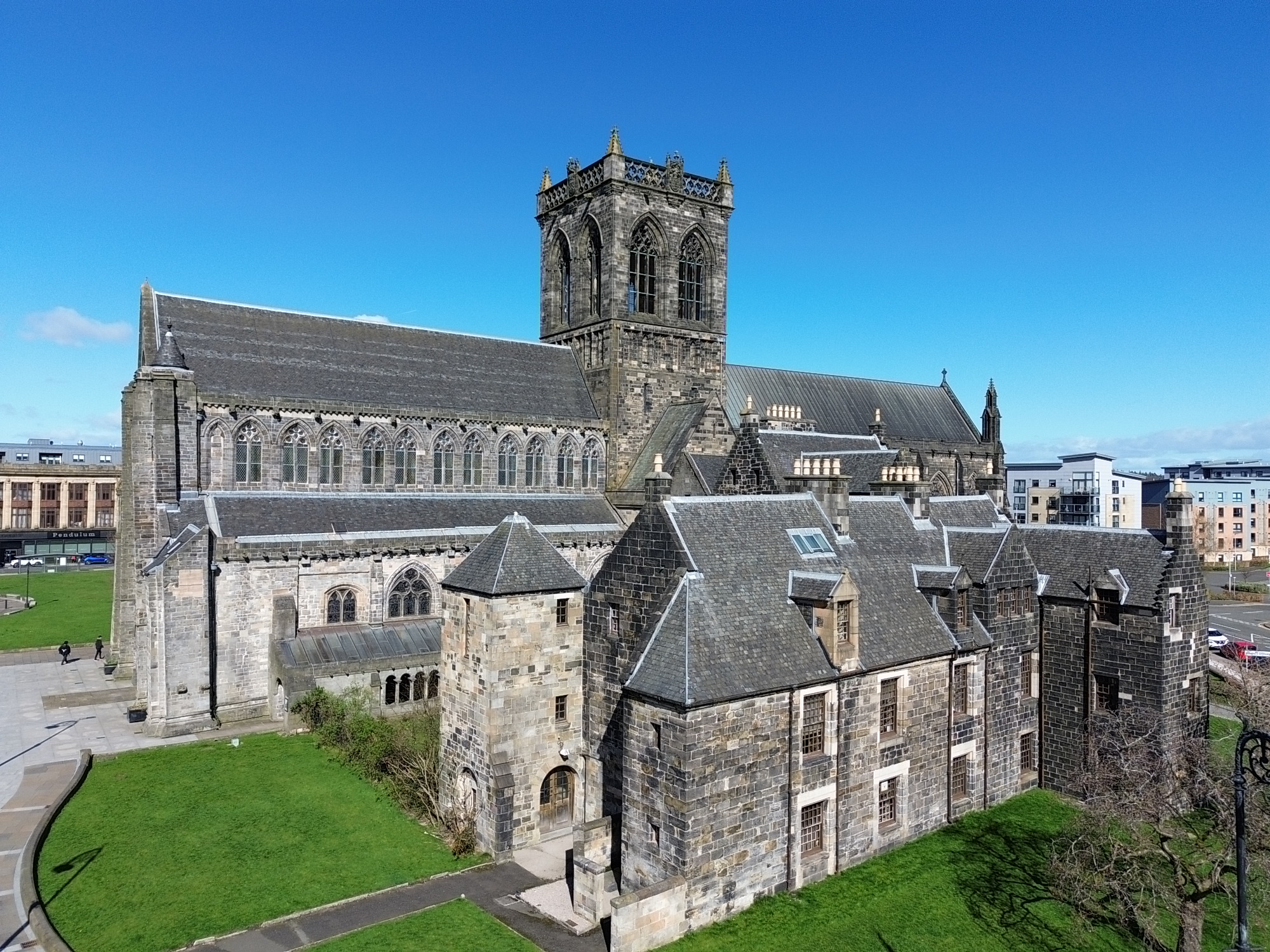
- Town Hall — Clark gift; restored as a cultural venue opposite the Abbey.
- Museum & Coats Observatory campus — Peter and Thomas Coats’s High Street / Oakshaw legacy; major redevelopment underway. Soft visit note only until public opening is confirmed: Museum campus.
- Abbey Close — Read thread philanthropy against medieval Paisley: Paisley Abbey.
Related: Heritage & History hub · Paisley pattern & shawls · Sma’ Shot Day
Further reading
- The rise of a threadmaking empire in Paisley – paisley.is — Clear Clark/Coats chronology from heddles to amalgamation.
- Our Heritage | Coats Group plc — Corporate timeline (attribute global headcount and market-cap claims as company heritage).
- The Death of Thread | Paisley People’s Archive — Oral-history-based account of 1970s–90s rundown (quote only with rights clearance).
- Coats Observatory | OneRen — 1883 founding, Thomas Coats, Town Hall time link, museum-campus status.
- 1882 – Town Hall, Paisley | Archiseek — W. H. Lynn; George A. Clark bequest and family funding.
- Paisley, Anchor Thread Works | Canmore / Trove — Industrial archaeology record for Anchor mills and demolitions.
- Sma’ Shot Day – paisley.is — 1856 weavers’ victory and modern festival.