Every July, Paisley holds a celebration that exists nowhere else. Drums sound, a parade winds through the town, and an effigy of a mean-fisted manufacturer goes up in flames. Sma’ Shot Day is one of Scotland’s most distinctive local festivals, and it commemorates something unusual: not a battle or a royal visit, but a pay settlement won by ordinary working people.
What was the “sma’ shot”?
At the height of the shawl trade, Paisley’s handloom weavers produced intricate patterned shawls for markets across Britain and beyond. To hold the elaborate design together, a fine binding weft — the sma’ shot, or “small shot” — was woven through the fabric. It was essential to the structure of the shawl but invisible to the customer’s eye.
Because it could not be seen, manufacturers refused to pay for it. The weavers had to supply and weave the thread at their own cost. To them it was a clear injustice: real work, done with real materials, that went unrewarded simply because it did not show.
The victory of 1856
The weavers campaigned over this for years. By 1856 they were at the height of their numbers and influence — paisley.is, drawing on Matthew Blair’s 1907 history of the shawl trade, puts the figure at more than 7,000 in the town (other sources give lower estimates). That year, agreement was finally reached, and a new table of prices that included the sma’ shot was published on 1 July 1856.
Why the first Saturday in July?
It was already the custom for Paisley weavers to take an annual summer outing on the first Saturday in July. Women and girls in weaving families who worked in the town’s thread mills asked for the same day off, so it became a shared holiday across the textile workforce.
In 1856 that holiday fell just days after the price settlement. According to local accounts, weavers gathered from each district at the “tuck of the drum”, marched with bands and banners to the railway station, and set off with their families for the coast — “doon the watter”. From then on the day was known as Sma’ Shot Saturday.
Outliving the weavers
As fashion turned against the shawl later in the nineteenth century, Paisley’s weaving population shrank. Yet the name survived: thread-mill workers kept up Sma’ Shot Saturday long after handloom weaving had all but disappeared. In 1904 it became an official trades holiday, and it remained one until the Second World War.
After the war, the spread of the five-day working week meant every Saturday was effectively a holiday, and the day ceased to be marked in the old way.
Revival in 1986
Interest in local traditions grew in the 1980s, and in 1986 community effort brought Sma’ Shot Day back. Since then it has become a fixture of Paisley’s calendar, organised as a family festival with music, performance and community groups taking part. Exact programmes change from year to year, so check Renfrewshire’s events listings for the current date and line-up.
The parade and the Burning of the Cork
Two elements give the modern festival its character.
- The parade — Traditionally led by the Charleston Drum, the procession moves through the town centre with bands, banners and colourful costumed groups.
- The Burning of the Cork — The “cork” was the weavers’ name for a manufacturer or employer. The festival climaxes with the symbolic burning of an effigy of the cork: good-humoured theatre, but a clear reminder of what the day commemorates.
Why it matters
Sma’ Shot Day captures something essential about Paisley. The weavers were known for their literacy, their debating societies and their radical politics — they had been at the heart of unrest across west-central Scotland during the 1820 Radical Rising. The sma’ shot victory is remembered not because the sum of money was large, but because it established a principle: hidden labour is still labour, and deserves fair pay.
Visit
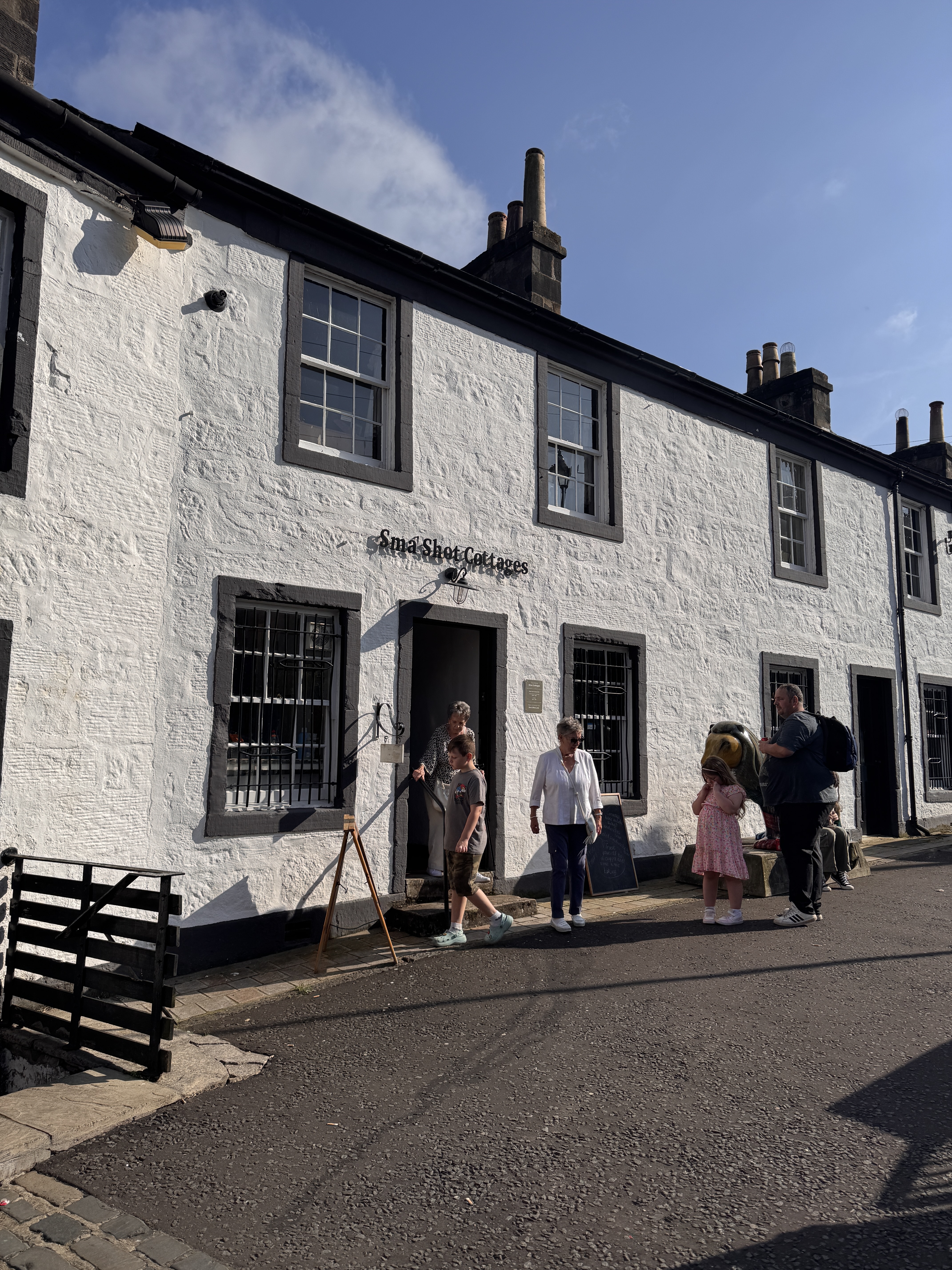
The Sma’ Shot Cottages on Shuttle Street are a pair of restored weavers’ and mill workers’ homes, with a loom and displays on domestic life. Check opening times before visiting, as they are seasonal and volunteer-run.
Related: The Paisley Pattern and Shawls · Thread Town: Coats, Clark and the Making of Modern Paisley · Robert Tannahill, the Weaver Poet
Further reading
- Sma’ Shot Day and a famous victory for the workers — paisley.is — Origins, the 1856 price table, 1904 trades holiday and 1986 revival.
- Matthew Blair, The Paisley Shawl and the Men Who Produced It (1907) — The classic early account of the shawl trade.