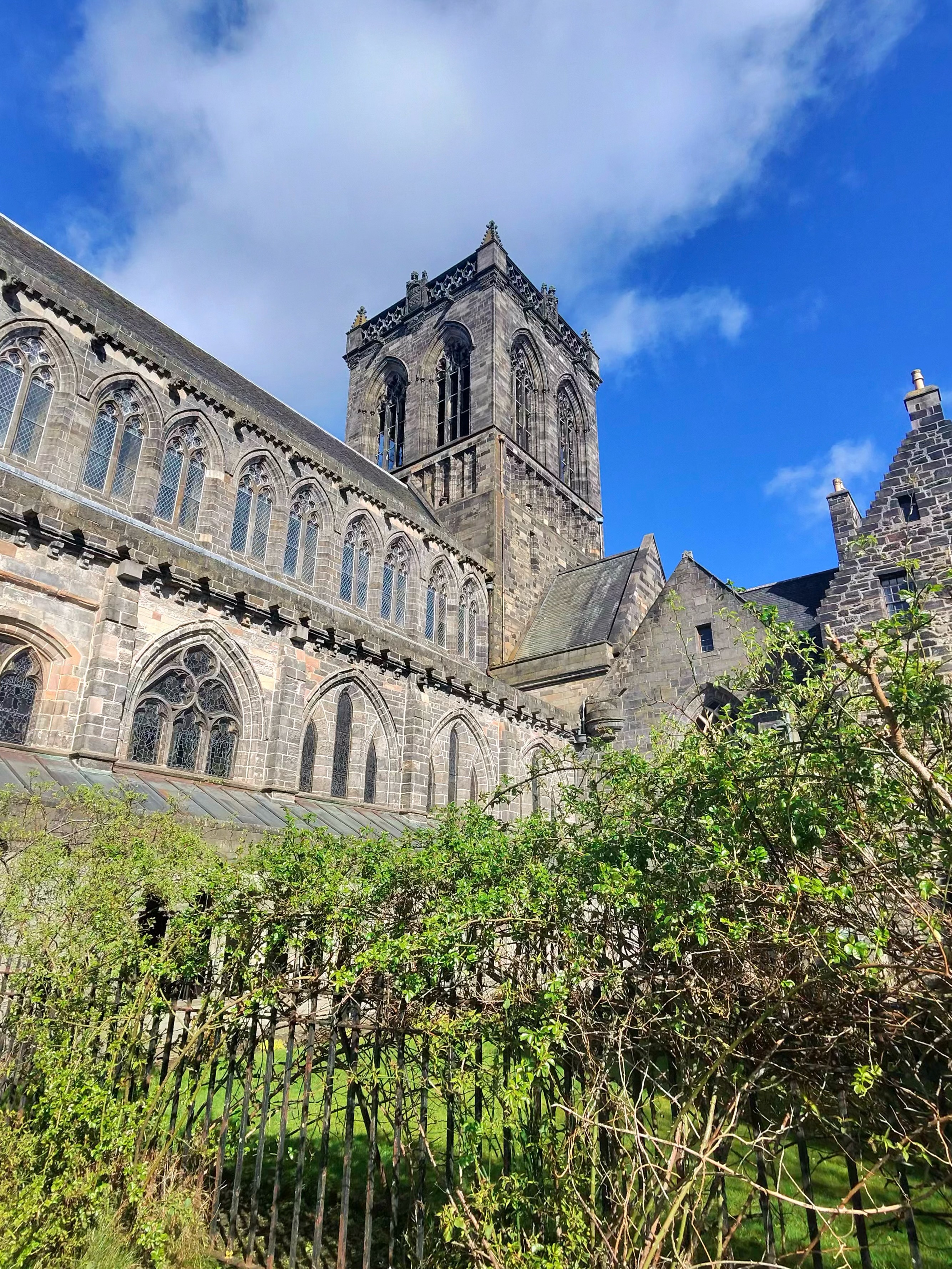
On the White Cart in the heart of Paisley stands one of Scotland’s great medieval churches — still a working place of worship, and still the building around which the town’s early story turns. For over 850 years it has anchored faith and civic life beside the Cart.
Founded as a Cluniac priory in the 1160s by Walter FitzAlan, first High Steward of Scotland, it grew into a wealthy house with royal ties, European trade, and a lasting claim as the “cradle of the Royal House of Stewart.” Fire, collapse, and Reformation left the nave alone as parish church for centuries; later restoration reunited nave, choir, and tower into the landmark you see today.
Explore more: Paisley Heritage & History · How Kashmir’s Motif Became “Paisley” · Sma’ Shot Day · Paisley Museum campus (redevelopment underway — check OneRen for current visitor info)
Early foundations and the St Mirin tradition
Local tradition holds that St Mirin established a church near a waterfall on the White Cart in the sixth century. The Abbey places its Cluniac foundation on that older Celtic site, and Mirin remains among its dedicatory saints.
That early chapter is traditional rather than firmly dated by archaeology. By the later twelfth century, though, this spot on the Cart was chosen for a major monastic house — and Mirin’s name stayed part of Paisley’s religious identity.
Cluniac priory and abbey
Around 1163, Walter FitzAlan — a Breton knight brought north by David I and made hereditary High Steward — founded a Cluniac monastery on his Renfrewshire lands. A foundation charter is traditionally linked to Fotheringhay, Northamptonshire. Thirteen monks came from Much Wenlock in Shropshire.
The house was dedicated to St Mary, St James, St Mirin, and St Milburga. Paisley became one of only two Cluniac abbeys in Scotland (with Crossraguel). Under royal patronage it grew wealthy, traded across Europe, and was known as a centre of learning. It is believed — Abbey tradition, not proven fact — that William Wallace was educated by the monks here.
In the thirteenth century the priory was raised to abbey status (commonly dated 1219 or 1245; sources differ). English forces burned much of the fabric in 1307; rebuilding followed in the fourteenth century. A further fire in 1498 led to more repair, including St Mirren’s Chapel on the south transept in 1499.
The Stewart “cradle” claim
In 1315 Walter Stewart, sixth High Steward, married Marjory Bruce, daughter of Robert the Bruce. The following year Marjory died at the Abbey after a riding accident nearby; her child survived and became Robert II, first of the Stewart monarchs.
The Abbey therefore claims to be the “cradle of the Royal House of Stewart.” It is the resting place of six High Stewards, Princess Marjory Bruce, wives of Robert II, and King Robert III — for whose memorial Queen Victoria provided a stone on her 1888 visit.
Wars, Reformation, and survival as parish church
In the mid-sixteenth century (secondary dates vary, including 1533 and 1553) the central tower collapsed, wrecking the transepts and choir. A wall was built across the east end of the nave.
At the Reformation in 1560 the monastery was disbanded. Buildings passed to the Hamilton family; the walled-off nave became Paisley’s parish church. Choir and transepts stayed ruined for roughly three and a half centuries. South of the church, the Place (or Palace) of Paisley later saw much humbler uses before the Kirk bought it back in the early twentieth century. Worship in the nave was what kept the Abbey a living church.
Restorations
Serious recovery began in the nineteenth century: James Salmon on the nave and transepts from the late 1850s; Rowand Anderson on transepts and lower tower; Peter MacGregor Chalmers on choir, vestry, and cloister; Sir Robert Lorimer on choir vault, upper tower, and furnishings. The Place of Paisley was bought back in 1907 (today’s shop and café).
In 1981 an open timber roof replaced the nave’s 1788 plaster ceiling. The result is an A-listed Gothic church still in use — one of the few Scottish medieval abbeys that remains a principal place of worship.
What to see today
- Nave, choir, and tower — Grey Gothic stone beside the White Cart, opposite the Town Hall. Surviving fabric ranges from early south-aisle and thirteenth-century west-front work to fifteenth-century and restored ranges.
- St Mirren’s Chapel — South of the crossing; medieval bas-reliefs; east window as Paisley’s war memorial.
- Barochan Cross — Free-standing cross (c. AD 900–1100); one of three complete Strathclyde survivors, and the most ornate. Kept in the Abbey; originally near Barochan, on a route to Dumbarton Rock. (Historic Environment Scotland)
- Stewart memorials — Including the Robert III memorial linked to Victoria’s 1888 gift.
- Wallace Memorial Window (1873) — Marks the traditional Wallace association.
- The Place of Paisley — Former monastic ranges; now shop and café.
- Abbey drain (archaeology) — Multiphase medieval drain south of the Abbey (SM8078), largely fourteenth–fifteenth century, with rare silts and organic remains — nationally significant, not a casual walk-through. (Trove SM8078)
Visit: paisleyabbey.org.uk for times and services. Pair with Town Hall on Abbey Close, then pattern, mills, and museum stories in town.
Related: Heritage & History hub · Paisley pattern & shawls · Sma’ Shot Day · Museum campus
Further reading
- History – Paisley Abbey — Foundation, Stewart claim, Reformation, restoration (primary narrative for this page).
- Paisley Abbey – Undiscovered Scotland — Accessible synthesis of fabric, restoration phases, and visitor highlights (useful cross-check; dates sometimes differ from the Abbey site).
- Barochan Cross | Historic Environment Scotland — Official note on the Strathclyde cross now in the Abbey.
- Paisley Abbey drain (SM8078) | Trove — Scheduled-monument designation and archaeological significance.
- HES listed building – Paisley Abbey (LB38910) — Statutory listing description and restoration sequence.