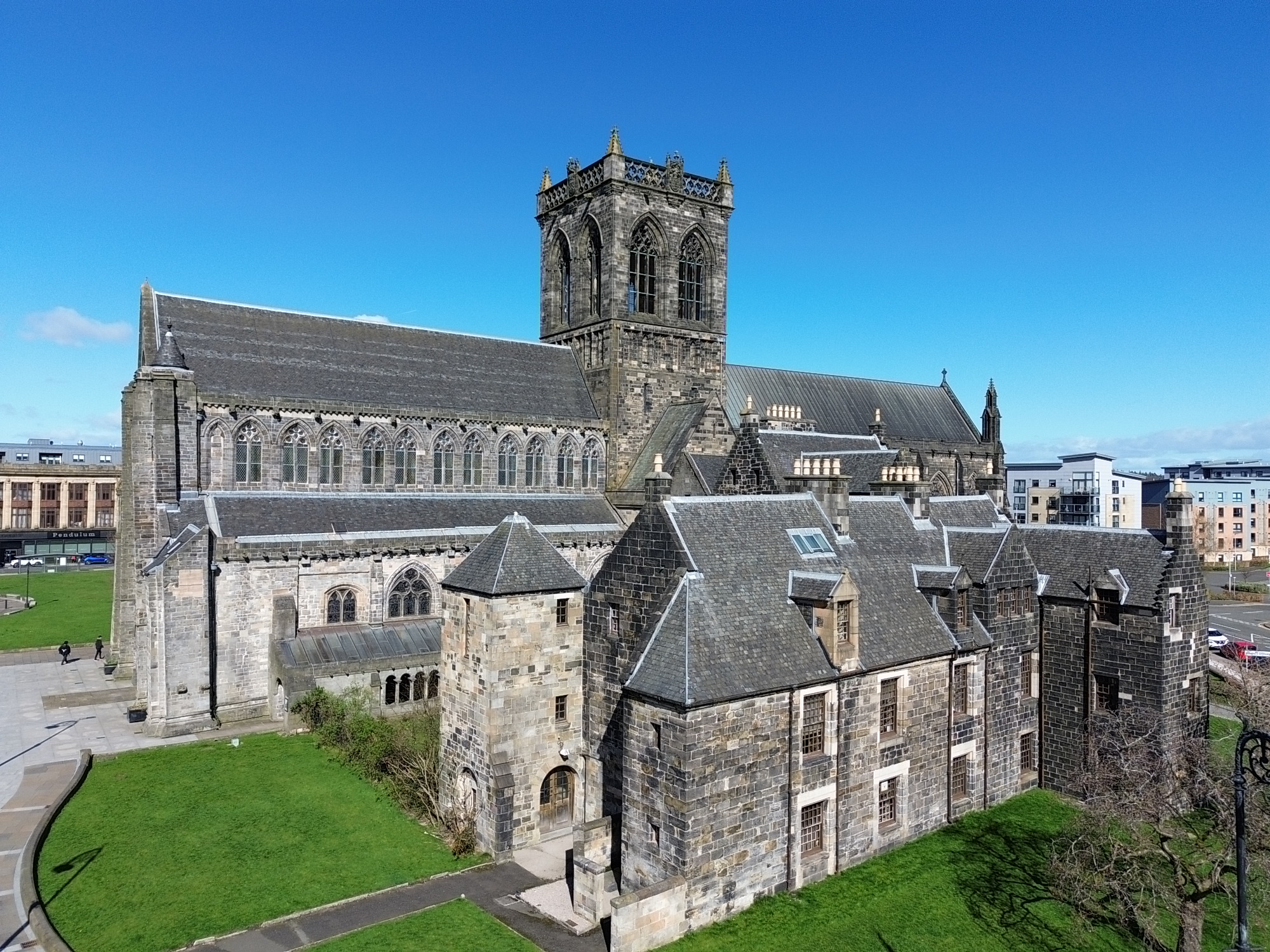
Paisley has produced poets, preachers and radicals, but none is more closely woven into the town’s identity than Robert Tannahill. A handloom weaver who composed verses at the loom, he wrote songs that are still sung far beyond Renfrewshire — though many who sing them have never heard his name.
Early life at the loom
Tannahill was born in 1774 in Castle Street, Paisley, one of a family of seven children. Like many Paisley boys of his generation, he left school at around twelve and was apprenticed to his father as a handloom weaver.
Once his apprenticeship was complete, he left town for work, spending about two years in Bolton, Lancashire. He returned to Paisley in 1801 to help support his family, and it was from this period that most of his poetry dates.
Weaving threads and verses
Accounts of Tannahill’s working life describe him composing as he wove, turning over lines at the loom and setting them down between lengths of cloth. Paisley’s weavers were famous for their literacy and their clubs and societies, and Tannahill moved in that world of reading, debate and song.
His most important creative partnership was with the composer Robert Archibald Smith, who set a number of his Scots songs to music. Tannahill’s lyrics celebrated the landscapes around Paisley — above all the Gleniffer Braes to the south of the town — along with love, friendship and the changing seasons.
“The Braes o’ Balquhidder” and “Wild Mountain Thyme”
Tannahill’s best-known song is “The Braes o’ Balquhidder”. It is widely regarded as the basis of the later folk song “Wild Mountain Thyme”, with its chorus “Will ye go, lassie, go?”, which has been recorded by countless artists. The later song was adapted and popularised in the twentieth century, so it is fairest to describe Tannahill’s work as its source rather than to credit him with the modern version.
The Paisley Burns Club
Tannahill was an admirer of Robert Burns, who had died in 1796. In 1805 he was among the founders of the Paisley Burns Club, which is often described as one of the oldest Burns clubs in the world. The club is now based at Tannahill’s Cottage on Queen Street, which houses a display of Tannahill and Burns memorabilia.
A tragic end
Tannahill’s life ended in 1810. Contemporary and later accounts describe him as distressed by the rejection of a revised collection of his work by a publisher and anxious about his health. He drowned in a culverted stream beneath the Paisley Canal. He was 35.
It is a story told with sensitivity in Paisley to this day, and it shaped the way later generations remembered him: as a gifted working man whose talent was not fully recognised in his lifetime.
Recognition after death
Recognition came after his death. In 1874 the centenary of his birth was marked with a new edition of his Poems and Songs and a procession to the Gleniffer Braes, which local sources report was attended by around 15,000 people. A series of annual concerts was then held on the Braes from 1876 to 1936.
The penny admission charged at those concerts helped to pay for the statue of Tannahill erected in 1883, which stands on Abbey Close opposite the entrance to Paisley Town Hall — a short walk from the Abbey and the weavers’ streets where he lived and worked.
Tannahill’s Paisley today
To follow in his footsteps:
- Tannahill’s Cottage, 11 Queen Street — home of the Paisley Burns Club (check access with the club before visiting).
- The Tannahill statue, Abbey Close — opposite the Town Hall.
- Gleniffer Braes — the hills that inspired so many of his songs, now a country park with views across Paisley and the Clyde valley.
Tannahill is, in many ways, the voice of the weaving town: skilled, self-taught, rooted in place, and remembered by the community long after the looms fell silent.
Related: The Paisley Pattern and Shawls · Sma’ Shot Day · Paisley Abbey: From Priory to Parish
Further reading
- Paisley’s weaver poet — paisley.is — Life, songs, 1874 centenary, concerts and statue.
- Robert Tannahill, Poems and Songs (centenary edition, 1874) — His collected work.