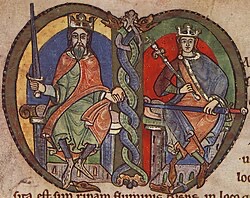
In 1164 a fleet of war galleys came up the Clyde to Renfrew, led by one of the most powerful men in the west of Scotland. Somerled, King of the Isles, never sailed home. His death on the edge of what is now Paisley and Renfrew is one of the best-recorded events of 12th-century Renfrewshire, yet it has gathered legends ever since: a saint's miracle, a treacherous nephew, and a lost stone on the Knock. Here is what the record says, and what tradition has added.
The sea king
Somerled, Somairle in Gaelic and Sumarliði in Norse, was a Norse-Gael lord who rose to rule Argyll, Kintyre and the southern Hebrides. He first appears on record in 1153, backing a rebellion against the Scottish crown by his kinsmen, the sons of Máel Coluim mac Alasdair. In January 1156 he fought his brother-in-law, Guðrøðr, King of Man and the Isles, in a bloody sea battle that ended with the kingdom split between them. Two years later Somerled drove Guðrøðr out altogether.
By Christmas 1160 he had made peace with Malcolm IV, King of Scots. Four years later he broke it.
The invasion of 1164
Why Somerled attacked is not known. He may have been reviving his kinsmen's claim to the throne, pushing back against Scottish lords settling the lands around the Firth of Clyde, or taking advantage of a king in poor health. The Chronicle of Melrose records that Malcolm suffered a "great sickness" in 1163.
The Chronicle of Mann puts his fleet at 160 ships, and Irish annals say his men came from Argyll, Kintyre, the Isles and Dublin. Modern historians suggest a force of perhaps 6,000 to 8,000, though medieval numbers are rarely reliable and later writers give other figures.
The chronicles agree that the fleet landed at Renfrew. That matters locally. Renfrew was held by Walter fitz Alan, the king's Steward, who only around a year earlier had founded the monastery that became Paisley Abbey. Somerled may have been aiming straight at him, although some historians think Herbert, Bishop of Glasgow, was the target. It is also possible that the fleet came ashore at Inchinnan.
A short, bloody fight
Whatever Somerled planned, it fell apart quickly. The most vivid account comes from the Carmen de Morte Sumerledi, a Latin poem by a Glasgow cleric who says he saw the invasion. It describes Somerled being wounded by a spear and cut down by a sword at the very start, by a hastily gathered body of local men. A priest, the poem says, cut off his head and presented it to Bishop Herbert. A son of Somerled died with him: the Annals of Tigernach call him Gilla Brigte. Leaderless, the islesmen gave up the fight.
Nobody recorded who led the Scots. Herbert, Baldwin the sheriff of Lanark and Walter fitz Alan are all candidates. The poem credits Herbert and makes no mention of Walter at all.
The legends
The poem is partisan. Its writer gives the victory to Glasgow's patron saint, Kentigern, through divine intervention. That is the first legend, and it was told within living memory of the battle.
The second comes from the other side. Much later Clan Donald tradition, set down in the 17th-century Sleat History and the 18th-century Book of Clanranald, holds that Somerled was not beaten in battle but murdered through treachery on behalf of the Scottish crown. Some retellings name a nephew in the king's pay. The contemporary sources point to a death in battle. Historians have suggested the treachery story grew up to explain how a leader remembered as almost unbeatable could fall so quickly.
Even his grave is disputed. A 19th-century tradition places it at Saddell Abbey in Kintyre. An older one, from the 17th century, says Iona, which historians think more likely.
The Knock and Queen Blearie's Stone
Renfrewshire has its own traditions about where it all happened. An 18th-century account has the invaders landing at Renfrew and marching south to the Knock, the rise midway between Renfrew and Paisley, where local forces defeated them. When the traveller Thomas Pennant came through in 1772, he was shown a mound with a ditch around it and a single stone on top, and told this was where Somerled was beaten. Nineteenth-century writers recorded a circular earthwork on Knock farm, the Kempe Knowe, which tradition named as the place of his death and burial.
Close by stood an eight-sided stone pillar about ten feet high, known locally as Queen Blearie's Stane. Accounts from the 17th century tied it to Marjory Bruce and the birth of her son, the future Robert II. In the 18th century, Lord Hailes suggested the name was a corruption of Gaelic cuimhne blàir, "memorial of battle", which would make it a monument to 1164 instead. Some historians have wondered whether the pillar on Walter fitz Alan's seal, which shows a figure leaning against one, refers to it. It is an attractive idea, but it cannot be proved.
The stone was dug up around 1779, part of it ended up as a barn lintel, and by the mid-1800s it had vanished. Its site now lies under housing around Wright Street in Renfrew. The cairn at Renfrew Road and Dundonald Road, unveiled in 1954 for Marjory Bruce, stands roughly 850 metres away. Our earlier post on Marjory Bruce tells her side of the story.
What came after
Somerled's kingdom broke apart. Guðrøðr was back in power in Man before the year was out, and the Isles were again divided between him and Somerled's sons. From them descend Clan Donald and the MacDougalls, and through Clan Donald the later Lords of the Isles.
There is a local postscript. At an uncertain date, probably after 1192, Somerled's son Ragnall made a grant to the priory at Paisley, the house founded by the family of the man whose lands his father had invaded. For more on that family and the abbey they built, see The Cradle of the Stewarts and Paisley Abbey: From Priory to Parish.
Further reading
- Battle of Renfrew – Wikipedia: The chronicle sources, the fleet, the possible commanders, the later traditions and Queen Blearie's Stone, with full references.
- Somerled – Wikipedia: His career, the Carmen de Morte Sumerledi, the treachery tradition and the burial question.
- The Marjory Bruce Cairn – Lairich Rig, Geograph: The Knock, Kempe Knowe and Queen Blearie's Stone, quoting Origines Parochiales Scotiae (1851), the New Statistical Account (1845) and 17th-century descriptions of Renfrewshire.
- Somerled – Undiscovered Scotland: A short biography that tells the betrayal version and the Iona and Saddell traditions.
- Parish of Renfrew – Gazetteer for Scotland (Ordnance Gazetteer, 1882–85): A Victorian account of the parish and its antiquities.