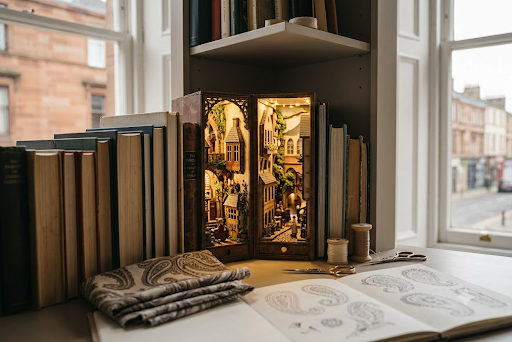
A book nook kit is a self-contained craft set that lets you build a tiny, illuminated diorama designed to slot between books on a shelf, creating the illusion of a hidden world beyond the spines. What began as a niche hobby among model-makers has, in the past three years, become one of the fastest-growing creative trends in the UK, and Paisley, with its deep-rooted textile artistry and thriving maker culture, may be the most fitting place in Scotland for it to take hold.
What Exactly Is a Book Nook?
A book nook is a miniature bookshelf insert, typically 15 to 30 centimetres tall, built to sit upright between volumes on an ordinary shelf. Most kits include pre-cut wooden panels, LED strip lighting, miniature furniture pieces, foliage, and illustrated backdrops. Assembled, they resemble a sliver of another world: a cobblestone alley at dusk, a candlelit library, a forest glade. The effect, especially once the lights are switched on, is genuinely striking.
Kits range widely in price and complexity. Entry-level sets cost roughly £20 to £35, while elaborate multi-room designs can reach £80 to £120. Most intermediate kits sit in the £40 to £60 range and require no prior craft experience beyond the ability to follow a diagram.
Where Did the Trend Come From?
The modern book nook is generally traced to a Japanese woodworker named Monde, who posted his first shelf-insert diorama online in 2018. The concept spread through craft communities, picked up by makers in South Korea and Taiwan who developed the modular kit format most people recognise today. By 2023, the kits had moved from niche hobby shops into mainstream retail, and UK sellers began stocking dedicated ranges in earnest.
The post-pandemic years produced an unusual appetite for slow, tactile, screen-free hobbies, and the book nook sits neatly at the intersection of miniature collecting, interior styling, reading culture, and handmade decoration. Unlike painting or knitting, which require practised skill to produce satisfying results, a quality kit can deliver something shelf-display-worthy within an afternoon. Those interested in exploring the different miniature worlds available can find out more here, which helps explain much of the category’s broad appeal.
Why Paisley Is Well-Placed to Embrace This Hobby
The connection between Paisley and intricate pattern-making is not accidental. The town gave its name to one of the world's most recognisable textile motifs, a teardrop design with roots stretching far beyond Scotland that became synonymous with the mills of Renfrewshire during the 18th and 19th centuries. The full journey is explored in the story of the Paisley Pattern, from its international origins to its transformation into a symbol of the town. That legacy of turning intricate repetition into something beautiful and tactile remains embedded in Paisley’s identity.
Paisley's ongoing regeneration has reinforced this connection. The Paisley Museum reopened in 2024 after a major refurbishment, with expanded galleries dedicated to the pattern's global history and the region's craft heritage. The town has actively positioned itself as a destination for creative tourism, creating fertile ground for craft hobbies that bridge the historical and the contemporary.
Local craft groups and independent makers in the area have already begun picking up the book nook format. The miniature bookshelf insert functions as a natural conversation piece: compact enough to display in a small flat, complex enough to occupy a full weekend, and visual enough to share on social platforms where Paisley's growing creative community is increasingly active.
Getting Started: What First-Timers Should Know
The single most common mistake among new builders is underestimating drying time. Most kits use PVA-based adhesives that need a full 20 to 30 minutes between layers to hold cleanly. Rushing this stage is the main reason finished pieces look untidy or fail to hold their shape.
A few practical points worth knowing before you open the box. The LED wiring is almost always the trickiest element for beginners. Most kits run on a USB cable or a coin-cell battery pack, so route the wire before you glue the back panel in place, not after. Natural light makes a significant difference when painting the small decorative pieces, and working near a window produces noticeably better results thanworking under standard indoor lighting. Keep a pair of tweezers and a cocktail stick to hand. They are not included in most kits but are genuinely indispensable for placing tiny foliage pieces and applying micro-drops of adhesive.
Is the Book Nook Trend Here to Stay?
There is reasonable evidence that it is. Craft trends that achieve mainstream retail distribution tend to stabilise rather than collapse, and the book nook category has now passed that threshold in the UK market. Specialist craft shops across Scotland have begun stocking miniature bookshelf insert kits as a permanent line rather than a seasonal novelty, which is a reliable indicator of sustained demand.
The hobby also attracts both older crafters with experience in model-making and embroidery, and younger adults in their twenties who discovered it through short-form video content. That cross-generational appeal is unusual and tends to support longevity. It also places book nooks within Scotland’s broader culture of independent making, represented by organisations such as Craft Scotland, which showcases contemporary makers, workshops and creative opportunities across the country.
For Paisley specifically, the alignment feels particularly well-suited. A town that spent two centuries perfecting the art of intricate, repeating design now finds itself with a community genuinely drawn to a hobby built on exactly those same values: patience, precision, and the quiet satisfaction of making something beautiful by hand.