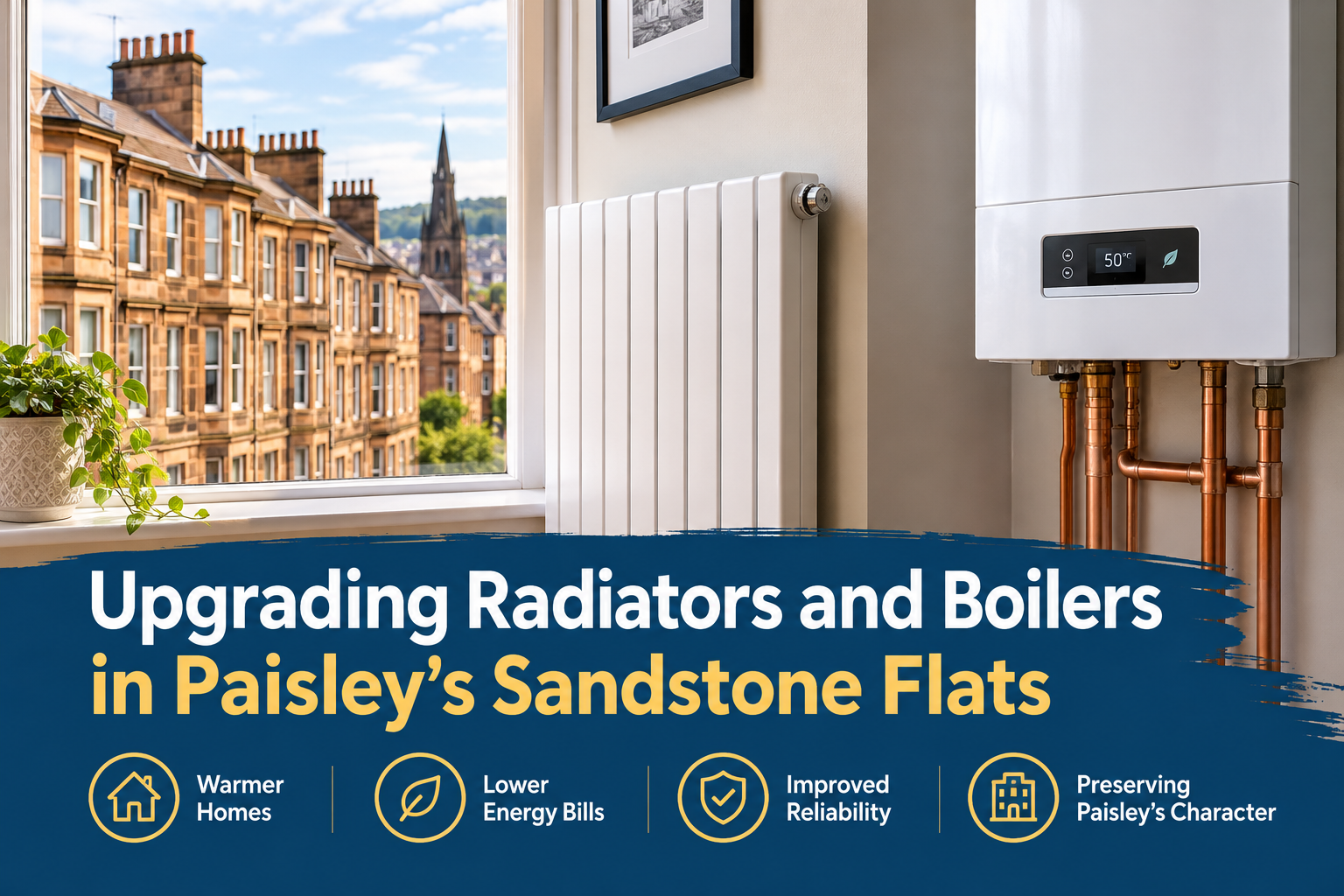
Paisley is known for its attractive, historic sandstone tenements, where solid stone walls, age, and often limited insulation can challenge homeowners aiming to maintain heat and comfort. In traditional flats with solid stone walls, heat loss through external walls can account for 45% of heat loss. Moreover, many flats are heated by gas boilers, and older, non-condensing boilers can achieve 55% to 78% efficiency, compared with around 93% from well-installed, modern condensing boilers. Upgrading boilers and radiators can therefore help strike a good balance between comfort and efficiency during the colder seasons of the year.
Why Sandstone Flats Can Be Difficult to Heat
Solid sandstone walls are often draughty and poorly insulated. Heat can escape through windows, floors, and unupgraded service penetrations. Because heat escapes quickly, traditional tenement flats often have high energy demand. Moreover, older heating systems may have issues such as sludge, limescale, and uneven radiator output, leading to inconsistent heating across the different rooms in a home. In some cases, ageing infrastructure means that boilers, radiators, and pipework are no longer functioning efficiently as a complete system. Another issue is that of damp and moisture. A Renfrewshire Council housing needs study found that approximately 42% of homes surveyed had serious issues. For instance, around 15% had condensation and 10% had black mould. The study also found that 48% of Renfrewshire households said their property required some repairs or improvements.
Obtaining an Assessment
Homeowners wishing to make the required upgrades can start by contacting a Paisley heating engineer to have their flat or tenement’s heating system assessed. During this assessment, professionals determine whether a home’s boiler and radiators can be safely upgraded without damaging the sandstone building or causing problems for other residents. During an inspection, the engineer can inspect the existing boiler and identify its age, fuel type, output, and condition. They also check the boiler’s location, gas supply, flue route, ventilation, and condensate drainage and determine if the boiler is safely accessible for servicing. They also look for signs of corrosion, leaks, and operational inefficiency. A straightforward assessment typically takes about one to two hours, although older tenements or systems with shared infrastructure may take a little longer.
Determining Heat Requirements
Engineers also measure or estimate each room's heat requirement based on its size, window area, insulation, exposure, and wall type. They check every radiator for issues such as cold spots, leaks, corrosion, and damaged valves. Flats should have even heating, which means radiators must be efficient and large enough to heat all spaces. In tenements, original cast-iron radiators are sometimes retained, cleaned, and reused if they are in good condition and compatible with new systems. Other areas to check include the pipework, walls, and windows. The engineer will assess how easy it is to access the boiler, pipework, and radiators for installation and future servicing, and identify whether the work affects shared pipework, communal areas, or other flats. Some communal heating or energy-efficiency improvements may require agreement from other owners.
Making Key Changes
Once the assessment is complete, the engineer may recommend power flushing if sludge or debris is restricting radiator performance. They may also suggest smart controls, zoning, and correctly set thermostatic radiator valves, which can reduce wasted heat and let occupants adjust each room's temperature to suit their needs. While pumps may be an option, poorly insulated tenement flats often need radiator and pipework upgrades to operate efficiently. In some cases, the solution may be as simple as fitting larger radiators and weather-compensating controls, which ensure that systems work effectively at lower flow temperatures. Because larger radiators have a larger surface area, they can release enough heat into rooms, even when the water passing through them is not extremely hot. These upgrades prepare flats for the future because low-carbon heating systems—especially heat pumps—work best with cooler water flowing around the radiators rather than the very hot water required by many older gas boilers.
Upgrading radiators and boilers in Paisley's sandstone flats involves identifying challenges and getting a professional assessment. An experienced engineer can make vital recommendations, including replacing old radiators and boilers. Improving the heating system can help offset heat loss through the building fabric while making it easier to maintain a comfortable indoor temperature efficiently.