Voice, ideas, interviews, and well-crafted conversations are the strengths of podcasts. However, today many digital platforms value content that is able to convey a message using moving imagery. Visual Adaptation keeps the original discussion and provides structure for viewers. AI production can repurpose audio content into structured scenes, captions, graphics, and supporting images. Pippit introduces these elements into a simplified process for converting podcast snippets into shareable video.
Why Podcast Audio Benefits From a Visual Layer
The meaning is conveyed through tone, words, pauses, and conversation in the audio, and through visuals as an additional comprehension layer. An AI video generator can convert the chosen concepts into scenes, which enhance the speaker's message. Captions make it more accessible and easier to understand in a noisy environment. Supporting footage may explain places, objects, processes, and/or concepts spoken about. Text highlights can be used to reinforce names, facts, jargon, or memorable conclusions, but should not be used to substitute for narration. Changes of scenes also provide visual pacing, which will help the audience realize that topics are changing. A helpful adaptation is to transcribe the dialogue instead of adding a waveform to still images. Pippit can add scripts, visuals, captions, voices, and editing elements to a more organized presentation.
Extract the Story Structure Hidden Inside Podcast Audio
In a long podcast, there are several smaller stories, arguments, explanations, and conclusions that can be visualized separately. When production requires dynamic scenes for concepts that fall within visual generation, Seedance 2.5 can be applied. First, find the main idea and best statements in each discussion section. Sort out supporting explanations from repetition of ideas, side conversations, and unrelated exchanges. Break up longer passages into sensible scenes with a clear purpose and readable scene transitions. Use footage, graphics, text, or speaker representation as appropriate for the informational role of each moment. Short adaptations can eliminate repetition and maintain context, intent, and essential meaning. This structure provides Pippit with more material to use to create a coherent visual sequence.
Plan Visuals Around Meaning Instead of Constant Motion
Good podcast videos are those with visuals that directly relate to the spoken content, rather than moving every second. Identify supporting details to correspond with topics, actions, locations, or ideas that the speaker explicitly mentions. Captions don't have to record everything that is spoken, but can highlight the key sentences. Use transitions as the discussion shifts topic, argument, mood, or stage of the story. Seeming continuity between scenes can be achieved through typography, framing, spacing, and visual treatment. Do not use visuals that are not found in the source that imply events, evidence, location, or outcome. Pippit maintains the visuals in the original discussion.
Steps to Turn Podcast Audio into Visual Stories with an AI Video Generator Platform
Step 1: Set up your podcast story
Sign up for Pippit through Google, TikTok, or Facebook.
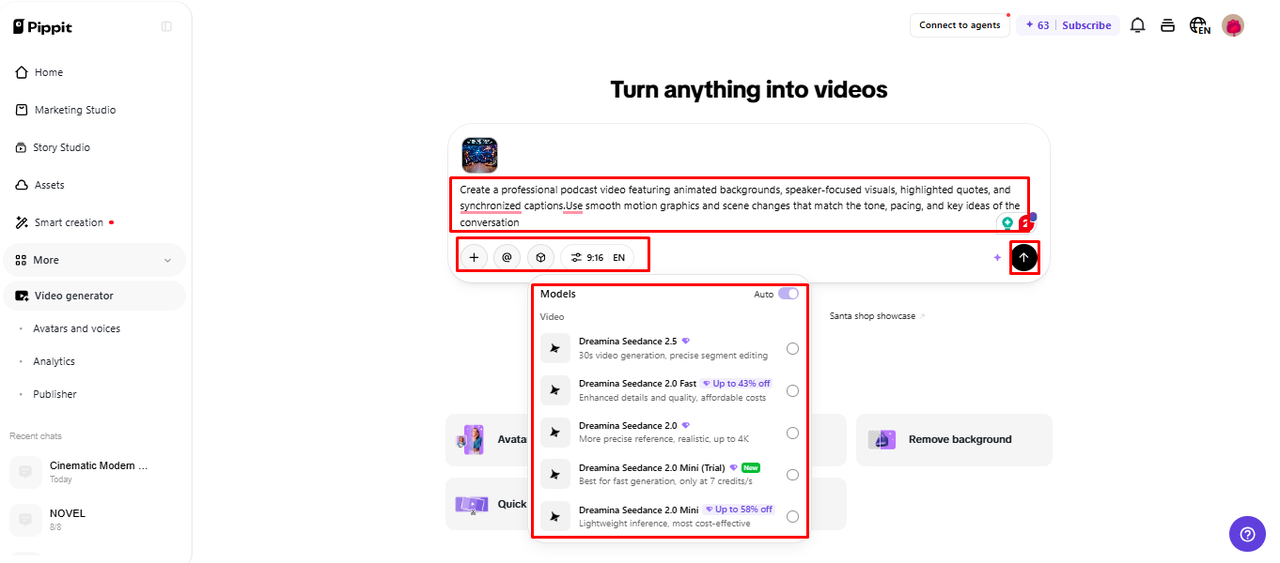
Open the "More" tab on the left and choose "Video generator".
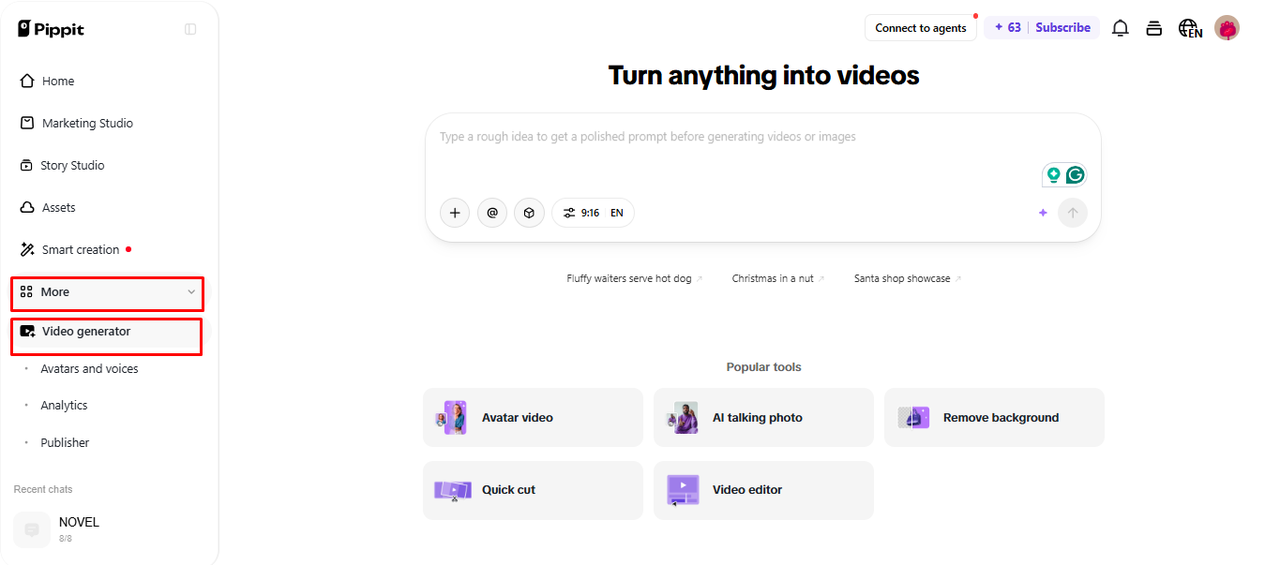
Select an AI model, such as Dreamina Seedance 1.0, Dreamina Seedance 2.0, Dreamina Seedance 2.0 Fast, Dreamina Seedance 2.0 Mini, or Dreamina Seedance 2.5.
Enter a prompt describing the podcast topic, visuals, pacing, and overall style.
You can also choose video length, language, subtitles, and aspect ratio.
Click "+" to upload reference images or videos from your device, phone, Dropbox, or a link. You can also use available assets.
Click "Generate" when ready.
Step 2: Create the visual story
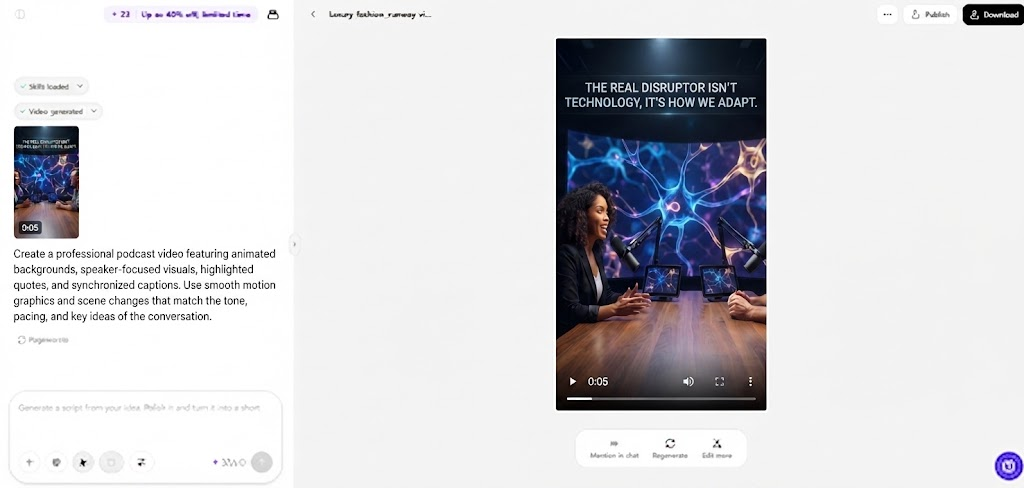
After clicking "Generate," Pippit creates a video using your prompt and reference media.
The AI handles transitions, pacing, captions, avatars, voice, lyrics, and visual enhancements.
Review the draft to see how well the visuals support the podcast content.
Step 3: Edit and publish
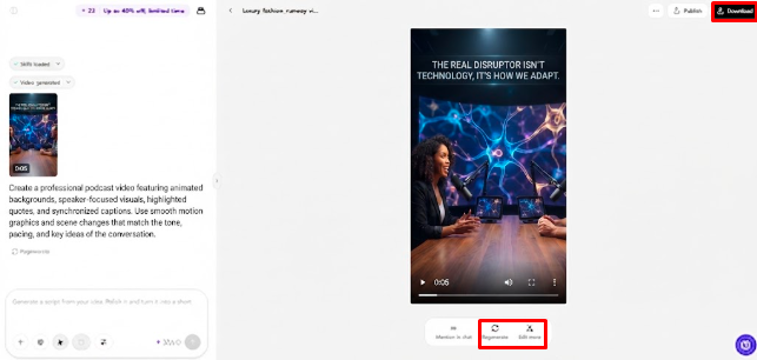
Click "Download" in the top right to save the draft. Select "Regenerate" for a new version or "Edit more" below the video for further changes.
Edit captions, add text, and adjust size, color, alignment, filters, and effects.
Add background music, remove backgrounds, or fine-tune the visuals.
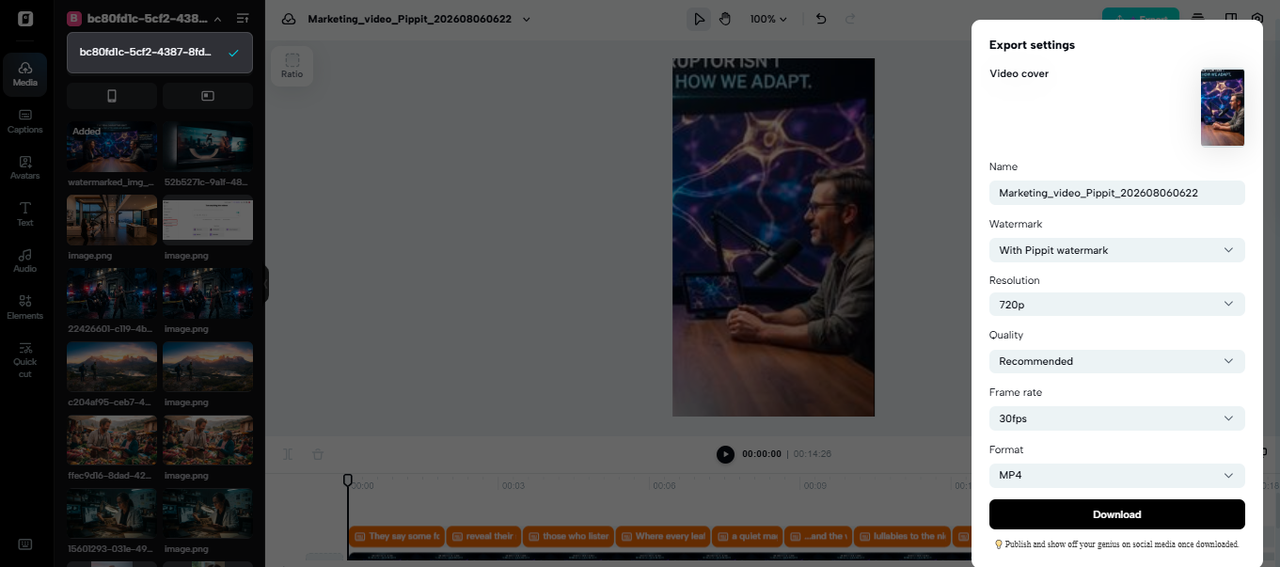
Click "Export" once editing is complete.
Choose "Publish" for TikTok, Instagram, or Facebook, or "Download" to select format, resolution, frame rate, and quality.
Build a Visual Story From Podcast Segments
A good adaptation is one that has a clear order of thought that reflects the development of the episode. Start with a hook (most important question, statement, or tension. Follow with context that sets up the topic before providing discussion or evidence. Development scenes can depict explanations, examples, comparisons, processes, or interactions between speakers. Make a separate section for the main idea that should be more visually prominent. Wrap up with a brief conclusion, takeaway, question, or "next step" message as appropriate. Use visual treatment for each section, rather than arbitrary motion, based on the content of each section. Key oral information needs to be fully accessible via appropriately timed captioning and clear scene composition. For long-form content, shorter clips can also be created to retain necessary context for social media.
Use Captions, Voices, and Visual Enhancements Strategically
The hierarchy of caption design should provide a hierarchy between the names, quotations, words, and main statements. Don't make it too difficult for viewers to read important words. Where a shorter adaptation demands restructuring (e.g., voice and/or narration), the source audio can be supplemented. Changes, however, should maintain the meaning of the original and differentiate new narration from dialogue. Avatars are most effective when they are used in a way that makes sense for a presentation instead of just being "there. Dialogue should be the primary focus, particularly during scenes where there is a lot of information to relay; music and sound effects should be used sparingly. Pippit's multilingual functionality can be used for adaptations designed for different language-speaking audiences. Consistent voice treatment, caption placement, and visual styling also reinforce continuity between different scenes.
Repurpose One Podcast Into Multiple Video Formats
When editors structure content around specific audience needs, several focused assets can be created from a single episode.
Break down key points of discussion into short snippets with clear beginnings and endings.
Summarize lengthy conversations and explanations visually on a given topic.
Create videos that highlight specific quotes that are either especially informative or memorable.
Create introductory/explanatory videos from chosen podcast content and visual aids.
Adjust dimensions, pacing, captions, and framing for various social publishing contexts.
This way can be used to continue conversations where recorded but does not require all adaptations to be of the same time. Pippit can facilitate these variations without losing the source material's main message.
Conclusion
When converting a podcast to video, images should be used to explain what is being said, but not to alter the message. Good structure allows you to recognize valuable parts and avoid overloaded or disconnected scenes. Captions enhance understanding, and meaningful pictures provide a more visual representation of abstract discussions. Longer conversations are also easier to follow if they are carefully paced when viewed in different viewing environments. Pippit simplifies the process of moving from oral content to structured, editable, and publishable visual storytelling.Click "Export" once editing is complete.