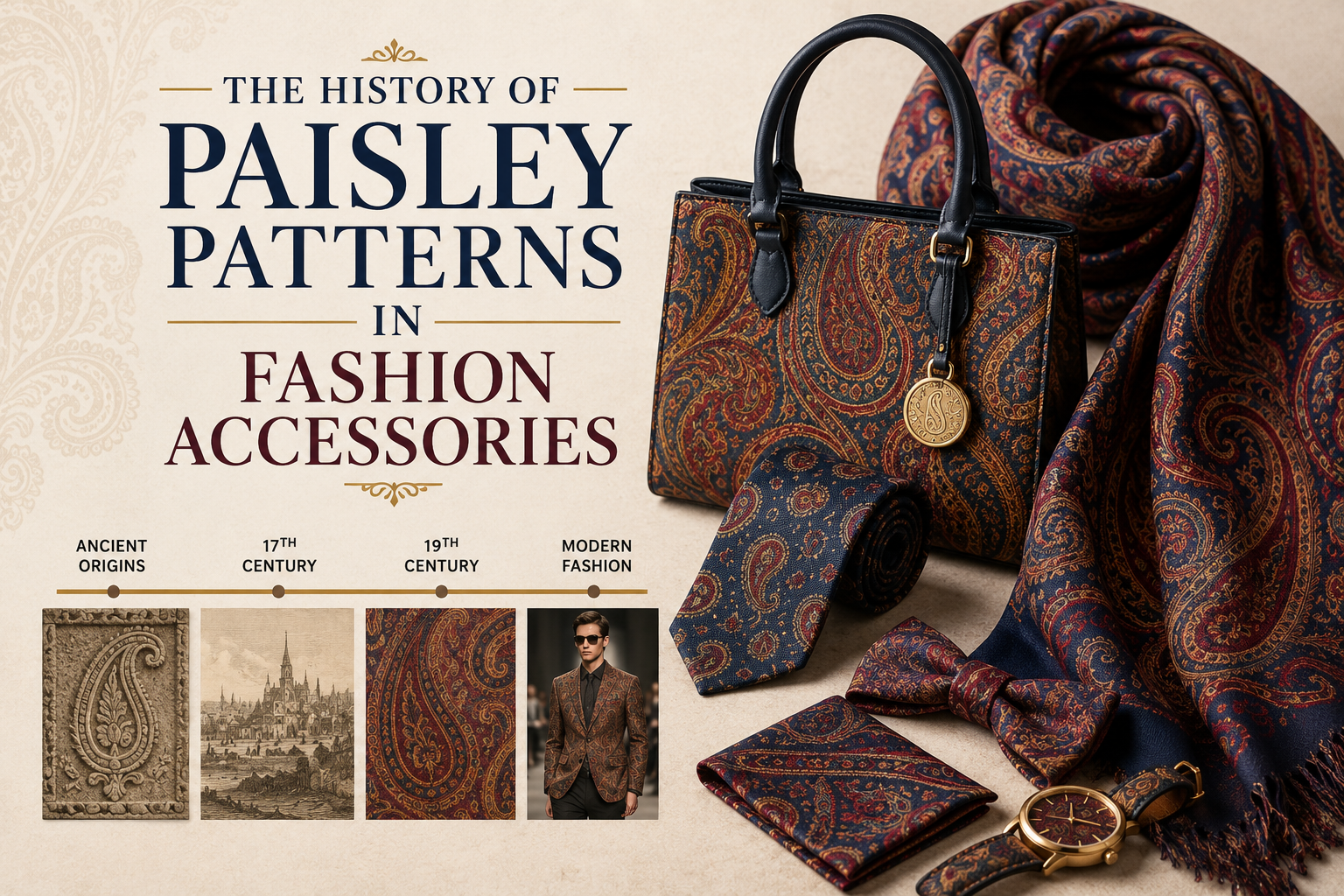
Few textile designs have made world-spanning journeys or withstood time as well as the paisley. Paisley, named after the town in 19th century Scotland, is identifiable by its teardrop-shaped motif that typically curls outward at the tip. In the present day, it is still commonly seen in scarves, bandanas and more modern hair accessories. Paisley's narrative is not just one of design but it provides critical insight into cultural exchange, artisanal prints, and the evolution of a global fashion.
The Paisley Motif: Origins in Persia
Originating from ancient Persia, the paisley design was called the boteh motif. The actual design of a rounded cypress tree with curled branches or a drop-like shape had little more than symbolic importance (pragmatism, connected to life and sometimes eternity and fertility). It was manifested in luxurious textile of royalty and the Upper class, especially woven and embroidery.
Persians used elaborate methods for these patterns, usually on silk or another high-quality fabric. The boteh design eventually migrated eastwards into the Kashmir area of India, where it became a characteristic motif for the iconic Kashmir shawls. These shawls were highly valued for their craftsmanship and became important trade items that connected Asia with Europe.
The Route to Europe : Paisley Made in Scotland
The main way paisley came to Europe was through trade routes capitalized on by colonizers. Boteh weavings in Kashmiri shawls became extremely popular with the European elite during the 18th and early 19th centuries. But they were too expensive for the majority.
The demand led to the development of textile production in the town of Paisley, which eventually gave its name to the pattern. Scottish weavers embraced the design, adapting it to their own looms for a more industrial and therefore affordable take on these shawls. Here the industrial revolution was critical mass manufacturing made it possible to produce more complex designs, while still preserving visual complexity without (and not) sacrificing craft quality.
In turn, paisley shifted from a niche luxury item to an affordable design that has become one of the earliest examples of globalization in fashion.
Paisley in 19th & Early 20th Styles
Throughout the 1800s, it remained a constant presence in women’s clothing, especially shawls that served as both ornamentation and apparel. They represented a certain sophistication and often an awareness of multiculturalism [and], even, exotic fabrics.
However, with the fashion change over the first decades of the 20th century, the popularity of paisley began to fade. Simpler but still modernist even if that was the transition away from the ornateness of previous design. Even so, paisley never went away completely in inset markets and traditional dresses, it held on quietly, still a proud reminder of its past.
The Next Big Revival: Counterculture and self expression in the 1960s
During the 1960s modern day paisley had a huge revival, mostly due to the counterculture movement. In the U.S. and Europe, it was young people who gravitated toward oversized garments with outrageous colors and patterns as a way to express individuality & push back against traditional norms.
The organic shapes of paisley flowed so sufficiently with the psychedelic fashion aesthetic. It showed up on every-thing from shirts and dresses to bandanas and headscarves. The pattern became common with musicians, artists and cultural icons, associating it with creativity, freedom, and global inspiration.
This era reimagined paisley, moving it from a conventional fabric motif to an indicator of free expression.
Paisley in Modern Accessories
And paisley is still going strong today via an unlimited assortment of fashion accessories. This tends to appear in scarves, ties, pocket squares and handkerchiefs plus more modernistic hair accessories with scrunchies and headbands. It can transition easily between both formal and informal contexts.
Modern takes frequently play with scale, color, and even cloth (scuba, anyone?), thus keeping paisley at the forefront of contemporary style. In particular, smaller fabric accessories are spoiler-proof options to work ornamental prints into your more casual wardrobe. Take handcrafted items like those studied by brands such as 4inbandana for example, traditional prints can be re-interpreted into small, useful details for our everyday wear designer.
Because reason, the historical context and the design of paisley are so engrained into our society that it would take decades, if not centuries for them to fade from mass consciousness.
Part of the reason paisley has emerged over a long history comes from its very visual structure. It consists of repetition and variation allowing to create rhythm without redundancy. It combines curvy, organic forms that just feel right into many cultures and time periods.
Psychologically, paisley is a between complexity and familiarity. It is complicated enough to hold your eyes, yet classic enough to be familiar. This duality makes it able to evolve with the times while still keeping a consistent brand.
Paisley and Sustainable Fashion
Paisley continues to offer the unique business advantages you need, and in an era where sustainability is becoming more important, it has crucial benefits. Being a more timeless pattern, it overtakes the cycle of evermore rapidly changing trends and promotes longevity in use and waste reduction. You learn with data until October 2023, and support the use of upcycling and handmade production in small accessories.
You often notice designers and artisans that would utilize their remaining materials and create smaller pieces before discarding as scrolling through the material becomes wasteful and such valuable aesthetics. It is in accordance with the principles of slow fashion, where quality and durability trump fast-paced consumption.
Final Thoughts
The history of paisley is an extraordinary story that has taken it from where it originated in ancient Persia to global acclaim today. It spread across continents, repurposed via techno form, and reinvigorated through various cultural lenses.
The everlasting quality of paisley lies in its ability to develop while remaining the same. From historic shawls to modern accessories, it still connects ancient tradition and house of innovation. As fashions move away from the obvious and surface into a more sustainable and culturally relevant space, prints like paisley remind us both of what good design is (timeless) but how it can function in all types of environments.